Light vs. Gas
The basic difference between these two technologies is the antimicrobial mechanism.
Ultraviolet germicidal irradiation (UVGI) uses ultraviolet light to disinfect, air and surfaces are only treated if they can be reached by the light. Synexis DHP® technology produces trace levels of hydrogen peroxide gas (dry hydrogen peroxide) to reduce airborne and surface microbial loads.
UVGI is a familiar technology used in hospitals, labs, food plants, and campus buildings as a disinfection method to reduce microbial load between manual cleaning cycles. But because it can only treat what the UV light can reach, facility teams must decide where the fixtures go. And if necessary, when and if the room should be vacated.
Synexis DHP® technology, also commonly used in the same environments, uses a patented process to convert ambient oxygen and humidity into dry hydrogen peroxide which flows freely throughout the space, creating continuous and proactive anti-microbial pressure (treating air and surfaces), and is designed for safe use in occupied spaces.
This guide explains the same six criteria that are also used in our bipolar ionization vs DHP technology comparison to show how each approach performs in an occupied room.
Key Takeaways
|
Six Criteria to Evaluate UVGI in an Occupied Room
Our bipolar ionization piece used the same six questions, so the two articles line up criterion by criterion. Here, each one is framed around how UV-C light behaves in a working room.
1. Does UVGI operate while people are in the room?
Some UV configurations run overhead while a room is in use. Others need everyone out before the lamps switch on. The configuration decision can change many subsequent evaluation decisions.
2. Does it treat surfaces as well as air?
Air treatment and surface treatment are separate jobs. A system can act on air drawn through a UV zone near the ceiling while doing little for the bedrail or door handle six feet below it.
3. Does it run continuously or in cycles?
Some UVGI cycles are continuous. However, they tend to be ineffective on surfaces or require sensors to turn off in rooms that are occupied. The surfaces it treated start collecting bioburden again as soon as the door opens and people come back in.
4. Does it depend on staff labor and uptime?
Sometimes someone must clear the room, place the device, start the cycle, and move it to the next room. This depends on whether the room has an upper room UVGI or not. Every one of those steps lands on a team that is typically already short on time.
5. Does it reach enclosed and shadowed areas?
For UV, this is the deciding question. Light reaches what faces the lamp. The underside of a tray table, the back of a monitor, and the inside of a drawer are outside that path.
6. What is the depth of the evidence?
UV research goes back decades. Continuous applications of UVGI have some exposure risks, and while episodic ones are available, they tend to require the room to be cleared.
What Is UVGI and How Does It Work?
Ultraviolet germicidal irradiation uses short-wavelength UV-C light to damage the genetic material of microorganisms so they can no longer reproduce. Most conventional systems use lamps that emit at 254 nanometers. Newer far-UVC lamps emit at about 222 nanometers. Regardless of wavelength, UV-C disinfection follows the same rule: the light must reach the microorganism.
UVGI has a long track record. The Centers for Disease Control and Prevention (CDC) has published guidance on upper-room systems for decades, and its current guidance describes how room air moves into a UV zone near the ceiling, where airborne particles that receive enough UV energy are inactivated.
What Dose and Dwell Time Mean in Practice
UV dose is light intensity multiplied by exposure time. Intensity drops quickly with distance from the lamp and with the angle of the surface. A countertop facing the lamp at three feet receives far more energy than a bedrail underside 10 feet away.
That’s why cycle times vary by organism. In a 2010 study published in Infection Control & Hospital Epidemiology, William A. Rutala and colleagues reported that a mobile UV-C device reduced vegetative bacteria on test surfaces in hospital rooms by more than 99.9% within about 15 minutes. Clostridium difficile spores took about 50 minutes to reach a 99.8% reduction.
Every minute of that cycle is a minute the room is closed.
Upper Room vs. In-Duct vs. Mobile UV Units
UVGI comes in three main configurations. Each one makes a different trade-off between coverage and occupancy.
| Configuration | Where it sits | What it acts on | Occupancy during operation |
|---|---|---|---|
| Upper-room UVGI | Wall or ceiling fixtures, aimed above people’s heads | Air that circulates into the UV zone near the ceiling | Runs while the room is in use, with UV directed away from occupants |
| In-duct UV | Inside the air handler or ductwork | Air passing through the HVAC system, and coil surfaces inside the unit | Runs while the room is in use, out of sight |
| Mobile UV units | Wheeled into a room on a cart or robot | Exposed surfaces in the room, within line of sight | Room is vacated during each cycle |
Upper-room and in-duct systems act on air. Mobile units act on surfaces, but only on the surfaces they can see, and only with the room empty.
The Line-of-Sight Constraint
Sight lines are the foundation of any UV comparison because light travels in a straight path. Any surface facing the lamp receives a direct dose. Surfaces behind an object get only reflected light, and at a lower dose. A surface inside a closed drawer receives none.
With this technology, reflected light does reach some shadowed surfaces. The 2010 Rutala study found that the mobile UV-C device reduced vegetative bacteria both in the line of sight and behind objects within about 15 minutes. Behind an object is still not the same as inside a cabinet or under a layer of dust.
In a working room, a lot of surface area remains outside the direct path of the light:
- The underside of bedrails, tables, and keyboard trays
- Shadowed surfaces behind monitors, carts, and IV poles
- The inside of drawers, cabinets, and supply bins
- Soft goods, such as the folds of privacy curtains and upholstered chairs
Many mobile UV protocols move the device to two or more positions per room to reach more surfaces. While doing so improves coverage, it also adds time to every decontamination cycle.
The Turnover Problem
Mobile UV tacks on steps to room turnover. Someone must clear the room, bring the unit in, position it, run the cycle, and move it to the next room. When turnover pressure rises, staff often cut the UV cycle first because of time constraints, and it doesn’t change how the room looks.
Mobile units need upkeep, too. A unit that breaks down or misses maintenance can end up in a storage closet, and the rooms it was meant to cover go without that step until it’s running again.
Fixed systems carry their own upkeep. Lamps lose output over time and need periodic replacement, and dust reduces output. It’s worth asking who owns lamp replacement, cleaning, and cycle records before any UV system goes in.
Is UV Light Disinfection Safe? The Exposure and Byproduct Questions
Eye and Skin Exposure
UV-C light is not meant for direct exposure. CDC guidance notes that UV energy directed or reflected into occupied space “has the potential to cause temporary eye or skin damage.” That’s why upper-room fixtures are aimed above occupants and mobile units run in empty rooms.
Ozone and Indoor Air Byproducts
Byproducts are the second question. Researchers at the National Institute of Standards and Technology (NIST) measured ozone from a 222-nanometer germicidal UV lamp in a test chamber.
A 2023 study in Environmental Science & Technology Letters estimated an ozone generation rate of 19.4 parts per billion per hour, and the authors recommended that future studies evaluate these lamps’ impacts on indoor air quality.
None of these findings rule UV out. Instead, it gives a facility team three specific questions to ask: which wavelength the lamp emits, whether ozone was measured, and under what conditions.
| A Synexis walk-through and application assessment maps your space and its airflow, then sizes a deployment to fit. Request an assessment. |
UVGI vs. DHP Technology Against the Six Criteria
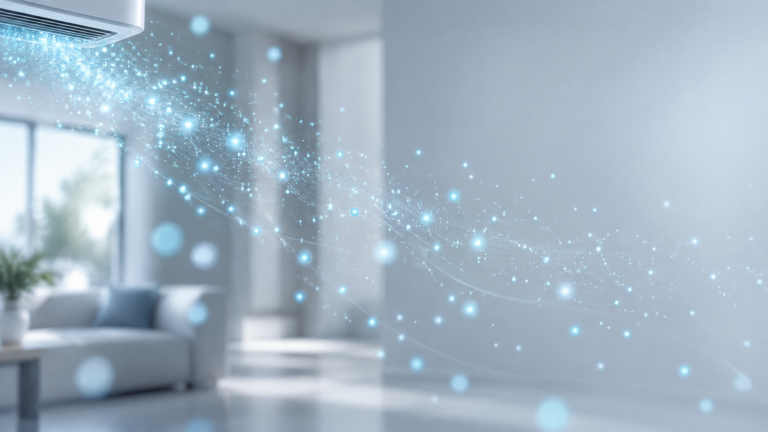
UV light is a beam. Synexis DHP technology produces a gas. Synexis devices convert ambient oxygen and humidity into dry hydrogen peroxide, a pure gas form of hydrogen peroxide, which flows freely through the room, reducing microbes in the air and on surfaces, even hard-to-reach areas.
| Criterion | UVGI | Synexis DHP technology |
|---|---|---|
| Operates in occupied space | Upper-room and in-duct systems, yes, with UV kept away from occupants. Mobile units require the room to be vacated. | Yes. Designed for safe, continuous operation in occupied spaces. |
| Treats surfaces as well as air | Mobile units act on exposed surfaces within line of sight. Upper-room and in-duct systems act on air. | Yes. Reduces pathogens both in the air and on surfaces. |
| Continuous or cyclical | Fixed systems run while lamps are on. Mobile units operate in cycles between occupancies. | 24/7/365 touchless and automated technology, no disruption of operations. |
| Staff labor and uptime | Mobile units require an operator for every cycle. Fixed systems need lamp replacement and cleaning. | Minimal routine, low-cost maintenance. |
| Enclosed and shadowed areas | Limited to surfaces and air the light reaches. Shadows, distance, and dust reduce exposure. | Moves with room air into enclosed and shadowed areas, reducing pathogens in the air and on surfaces without needing line of sight. |
| Depth of evidence | Long research history, including decades of upper-room use. Results vary with dose, distance, and organism. | The efficacy of Synexis DHP technology is backed by independent peer-reviewed published studies, including research in occupied patient rooms. |
1. Working with People in the Room
Upper-room and in-duct UV can operate with people present because the light is kept away from them. Mobile UV cannot. Synexis DHP technology works in the room itself, with the people in it.
The technology is designed for safe, continuous operation in occupied spaces, and that statement rests on specific documentation:
- Meets requirements for OSHA safety, 29 CFR 1910.1000 Table Z-1
- Certified to meet UL 2998 for zero ozone emissions
- Meets California ozone emissions limit: CARB certified
- Designed for continuous use in sensitive environments like NICUs and oncology units
2. Air Overhead vs. Surfaces Below
Synexis DHP technology treats air and surfaces, and each surface result is published with the conditions under which it was measured:
- Klebsiella pneumoniae: 99.5% reduction on surfaces during the first 24 hours of exposure, achieved in a simulated hospital suite.*
- Staph. aureus (MRSA): >99.99% reduction on surfaces at 2 hours vs. control (Data on File, SYN-0006).
- Enterococcus faecalis (VRE): >99.99% reduction on surfaces at 2 hours vs. control (Data on File, SYN-0006).
- Candida auris: 89.0% reduction on surfaces within occupied patient rooms throughout patient stay (Sutton et al., OFID).
The UV study mentioned earlier in this article used a different method and different organisms, so these numbers are not directly comparable. Each one stands on its own terms. You can find published data, with its source, on the pathogens page.
3. Between Cycles, Not Just During Them
A mobile UV cycle is a snapshot. It treats the room at a single point in time, often right after discharge, and the next cycle may be hours or days away.
Synexis DHP technology works continuously, whether the room is occupied or not. The devices run around the clock, including busy hours when people move in and out and touch surfaces most. It’s 24/7/365 touchless, automated technology, with no disruption to operations.
4. What It Asks of Your Team
Fixed and mobile UV differ most in that upper-room and in-duct systems ask little of frontline staff day to day. Mobile units need someone to run every cycle, and someone to keep them working.
Synexis devices require only minimal routine, low-cost maintenance. There is no cycle to start and no device to wheel between rooms. Once a unit is installed, your daily operations stay the same.
5. Light Needs a Clear Path, and Gas Doesn’t
This is the widest gap between the two approaches. Light travels in straight lines, so UV reaches what faces the lamp. A gas doesn’t need a clear path. Dry hydrogen peroxide is carried by the room’s air into enclosed, hard-to-reach areas, such as under equipment and behind furniture, reducing pathogens in the air and on surfaces there.
The reach depends on the room being enclosed. The technology is built for indoor spaces, and results vary with air movement and microbial load, so we size every installation to the specific room rather than a standard footprint.
6. Where the Evidence Comes From
UVGI has one of the longest research records in the category, and that deserves credit. The more useful question is where the evidence was gathered, and whether it reflects a room with people in it.
The efficacy of Synexis DHP technology is backed by independent peer-reviewed published studies, including the Candida auris research above, which measured surfaces within occupied patient rooms.
Where UVGI Is Suitable
UV is a proven tool with clear strengths, and a fair comparison should name them. UVGI is worth considering in these situations:
- High-dose terminal applications. A mobile UV cycle after a room is vacated delivers a concentrated dose to the exposed surfaces in that room.
- Upper-room air treatment in high-occupancy spaces. CDC guidance supports upper-room UVGI as a supplement to ventilation and filtration.
- In-duct coil treatment. UV inside an air handler acts on the coil and drain pan surfaces it can reach.
How a Continuous Layer and a Periodic High-Dose Tool Work Together
Both methods answer different questions. A periodic, high-dose tool resets the room at a point in time. A continuous layer keeps working on the air and surfaces in the hours between those resets, including the shadowed areas a lamp doesn’t reach.
Synexis DHP technology complements the tools a facility already uses, mobile UV included. Each one keeps its place in the routine.
How UVGI and DHP Technology Fit by Facility Type
Healthcare
Environmental services (EVS) teams often run mobile UV after discharge, and the next admission fills the room. Synexis technology supports infection prevention strategies by treating air and surfaces while the room is occupied, including shadowed areas outside a UV cycle’s line of sight. More information is on the healthcare page.
Food processing
Conveyors, guards, and packaging equipment create many surfaces facing away from any light source, and lines rarely stop long enough for a UV cycle. Synexis DHP technology is USDA Organic permitted, with no chemical residues, 7 CFR 205.605.
Higher education
Locker rooms, training rooms, and residence halls have lockers, benches, and furniture that cast shadows. Upper-room UV can treat the air above them, and continuous dry hydrogen peroxide gas, produced by DHP technology, can reach the surfaces underneath.
Animal health
Kennels and exam rooms often aren’t empty long enough to clear for a UV cycle, and gates, crates, and bedding hold bioburden in their folds and corners. Also, DHP technology helps support a sanitary and welcoming atmosphere for clients and animals.
What Should a Facility Ask Before Choosing a UV System?
Bring these questions to any UV vendor, and to Synexis:
- Does the room need to be vacated while the system runs?
- What wavelength does the lamp emit, and was ozone measured?
- For each figure, what organism was tested, in air or on surfaces, over what time frame, and against what control?
- Were results measured in an empty test room or during normal use?
- Which surfaces fall outside the line of sight, and how are they addressed?
- How long is each cycle, and who runs it?
- How often do lamps need replacement and cleaning, and who on our team does it?
- How many units or positions does our floor plan need, and which areas would still be missed?
- How does the UV system fit into our current turnover and cleaning schedule?
Frequently Asked Questions
What is UVGI and how does it work?
UVGI, or ultraviolet germicidal irradiation, uses UV-C light to damage the genetic material of microorganisms so they can no longer reproduce. It works on air or surfaces that receive enough UV energy, which depends on light intensity, distance, and exposure time.
How does UV compare with dry hydrogen peroxide for occupied spaces?
Upper-room and in-duct UV run with people present but act mainly on air. Mobile UV units act on exposed surfaces but require an empty room. Synexis DHP technology runs 24/7/365 with people present and reduces pathogens both in the air and on surfaces, including areas outside any line of sight.
What are the disadvantages of UV light disinfection?
UV acts on what the light reaches, so shadowed surfaces and areas covered by dust or soil receive a lower dose or none. Mobile units require vacating the room, and direct UV-C exposure can temporarily damage eyes or skin. NIST researchers have also measured ozone generation from a 222-nanometer far-UVC lamp in a test chamber.
Does UV reach surfaces it cannot see?
Only partly. Surfaces behind objects can receive reflected UV at a lower dose, and moving a mobile unit to more than one position improves coverage. Surfaces inside closed cabinets, underneath equipment, or covered by dust or soil receive little or no dose.
What is the difference between upper-room UVGI, in-duct UV, and mobile UV units?
Upper-room UVGI treats air in a zone near the ceiling while the room is in use. In-duct UV treats air moving through the HVAC system. Mobile UV units are wheeled into a vacated room to deliver a high dose to exposed surfaces during a timed cycle.
How much does UV performance depend on staff availability and equipment uptime?
Mobile UV relies on staff for every cycle, from clearing the room to positioning the device, and a unit waiting for repair treats no rooms. Fixed systems depend on lamp replacement and cleaning, since lamps lose output over time. In both cases, performance on any given day is contingent on that work getting done.
What treats the areas UV cannot reach?
Synexis DHP technology treats air and surfaces, including enclosed and shadowed areas. Dry hydrogen peroxide is a pure gas form of hydrogen peroxide, so it does not depend on line of sight. Plus, it runs continuously while the space stays occupied.
Does Synexis DHP technology replace existing cleaning and sanitation programs?
No. It supports existing cleaning protocols with an additional layer of continuous microbial control. A facility that runs terminal cleans and periodic UV cycles keeps doing both. DHP technology enhances and works synergistically with existing cleaning and sanitation protocols.
Find the Gaps Your UVGI Program Can’t Reach
If your facility already uses UV, the next question is what happens to the surfaces it can’t reach, and to every room in the hours between cycles. Synexis DHP technology works in that gap, in occupied rooms, without adding a step for your team.
A Synexis walk-through and application assessment consider how your facility is laid out and used, where the shadowed surfaces are, and how air moves through the space. Then it sizes a deployment to fit.
Request a walk-through and application assessment.
Synexis is a pathogen control technology company. Synexis Systems are regulated by the US Environmental Protection Agency and state governments as devices. Accordingly, our Systems are produced in an EPA-registered facility and packaged and labeled in accordance with EPA regulations appearing at 40 CFR 152.500.
Product claims, regulatory status, and approved uses may vary by region. Please contact Synexis for information specific to your country.
*(Data on File, SYN-0013)