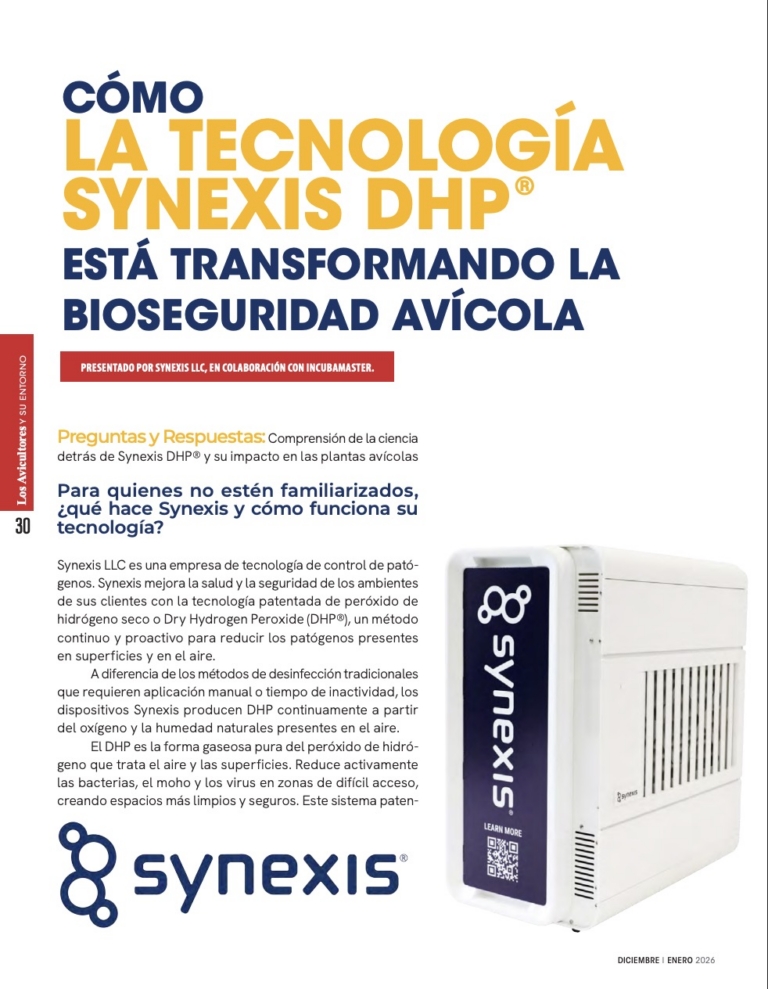
Most facility teams evaluating air and surface technology aren’t looking at an empty room. They’re looking at a nursing unit, a packaging line, a residence hall, or an exam room that stays in use from the first shift to the last.
Bipolar ionization is marketed heavily for those spaces. It’s sold into healthcare, food processing, higher education, and animal health.
Synexis DHP® technology is another option built for the same rooms. Both are designed to run while people are present, but they differ fundamentally in the persistence and reach of the active agent. DHP technology employs a stable molecule that can travel throughout a treated space. By contrast, bipolar ionization produces a mixture of ionized gas, or plasma, whose ions have a lifespan of less than 1 second after release before reverting to the original reagents of humidity and oxygen. Consequently, bipolar ionization’s particulate-removal efficacy can decrease sharply with distance from the ionization device as the concentration of surviving ions falls. The central contrast is a short-lived ion cloud versus a stable, room-filling molecule.
Key Takeaways
- Bipolar ionization releases charged ions, usually through the HVAC system, that act mainly on airborne particles. Those ions typically persist for less than 1 second after release, so their concentration—and particulate-removal effect—declines with distance from the device.
- The Environmental Protection Agency (EPA) describes bipolar ionization as an emerging technology and notes that little research evaluates it outside of lab conditions.
- Synexis patented DHP® technology is a proactive and continuous pathogen control method designed for occupied spaces. DHP technology converts ambient oxygen and humidity into the pure gas form of hydrogen peroxide (or dry hydrogen peroxide). Dry hydrogen peroxide flows freely throughout the space and deactivates microbes by breaking down the key structures, reducing airborne and surface-level pathogens.
- Neither technology replaces a cleaning program. The useful question is what happens to the air and surfaces in the hours between cleanings.
6 Criteria to Assess Any Air and Surface Technology
Before comparing mechanisms, it helps to agree on the questions. These 6 apply whether the space is a sterile processing department, a ready-to-eat packaging room, a lecture hall, or a boarding kennel.
1. Does it operate while people are in the room?
A technology that needs the room cleared only works when the room is empty, and in most facilities that’s rare and brief.
2. Does it treat surfaces as well as air?
Microbial load settles. Keyboards, bed rails, conveyor guards, and kennel gates hold bioburden long after the air has moved on.
3. Does it run continuously or in cycles?
Anything episodic resets a room to a known baseline and then leaves. What matters is the next 14 hours, as staff, visitors, and equipment move through.
4. Does it depend on staff labor and uptime?
If it needs an operator, a schedule, or a room taken offline, it competes with every other task on the shift.
5. Does it reach enclosed and shadowed areas?
Think behind equipment, under counters, inside cabinets, and the far corner away from the supply diffuser.
6. What is the depth of the evidence?
Ask whether efficacy has been validated in independent, peer-reviewed studies and in real-world occupied settings—not only in controlled chambers. Synexis DHP technology has been evaluated in more than 13 peer-reviewed studies, while EPA notes that substantially less evidence is available for bipolar ionization outside laboratory conditions.
What Is Bipolar Ionization and How Does It Work?
Bipolar ionization devices apply high voltage to air as it passes between electrodes, creating positively and negatively charged ions a mixture of ionized gas called plasma. Most commercial systems are installed in air handlers or ductwork, although portable units also exist, and manufacturers claim these ions travel into occupied spaces with the supply air.
The majority of peer-reviewed evidence indicates that the ions have a lifespan of less than 1 second after release before reverting to the original molecular components, such as oxygen. As distance from the ionization device increases, fewer ions survive, and contaminant removal efficacy can decrease accordingly. Dry hydrogen peroxide is distinctly different: it is a stable molecule designed to travel throughout a treated space.
The EPA notes one specific type of BPI designed to avoid creating ozone is needlepoint bipolar ionization. The name comes from fine-tipped emitters, often carbon fiber, that generate ions at lower energy than older designs. Manufacturers describe 2 main effects:
- Particle agglomeration. Charged particles cluster together, which makes them larger and easier for the building’s filters to capture.
- Interaction with airborne microbes. Ions attach to some airborne bacteria and viruses and alter their surface proteins.
Some manufacturers also market reductions in odors and volatile organic compounds (VOCs). If you’ve searched for GPS bipolar ionization, you’ve seen one manufacturer’s needlepoint systems, which that manufacturer states carry UL 2998 certification for zero ozone emissions.
What Does a Bipolar Ionization HVAC Setup Look Like
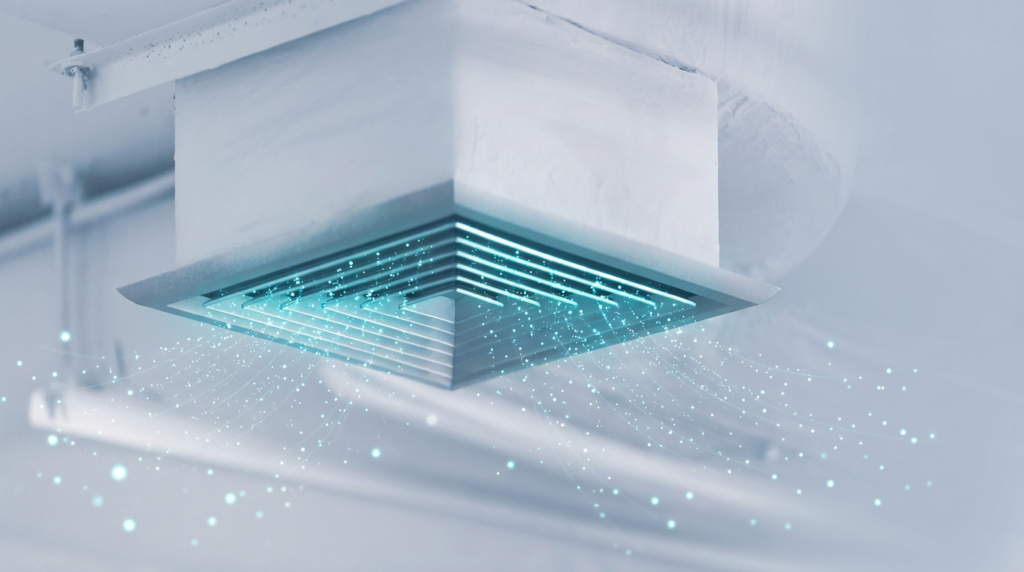
A bipolar ionization system is usually mounted near the fan or cooling coil so ions are carried downstream. That’s a large part of its appeal to facility teams: it goes in once, it’s out of sight, and it runs whenever the air handler runs.
It also means the technology’s reach follows the airflow. Ions are short-lived in room air, if they escape the HVAC system at all. How many reach a given spot in a room depends on distance from the supply, air speed, and how quickly ions recombine or attach to particles.
Does Needlepoint Bipolar Ionization Work?
The fair answer is that it depends on where it’s measured.
Results In Sealed Test Chambers
According to Science Direct, EPA researchers conducted a large-scale evaluation of microorganism inactivation by bipolar ionization and photocatalytic devices in an operational-scale chamber with a recirculating HVAC system.
After 1 hour, the study reported reductions in an airborne surrogate virus (MS2 bacteriophage) of up to 0.88 log10 compared with control tests. Surface deposition showed no meaningful difference between technology and control conditions.
A separate large-chamber study, published by Science Direct, of an in-duct ionizer found that the ionizer alone had a negligible effect on particle concentrations and particle loss rates. Paired with MERV 10 or MERV 13 filters, it added an estimated 8 to 10 percentage points of PM2.5 removal efficiency.
Results In an Occupied Room
During a test published by ACS ES&T Air, researchers ran an in-duct ionization system in a university lecture hall with the ionizer off, on with variable fan speed, and on with constant high fan speed. They found no significant differences in culturable airborne bacteria whether the ionizer was on or off.
That gap between chamber and room isn’t unique to ionization. A sealed chamber controls airflow, humidity, and microbial load. An occupied room controls almost none of them. It’s the reason any figure, from any vendor, should come with its organism, medium, timeframe, and comparator attached.
What Does the EPA Say About Ionization Devices?
The EPA’s guidance on bipolar ionization calls it “an emerging technology” and states that “little research is available that evaluates it outside of lab conditions.” It adds that “the evidence for safety and effectiveness is less documented than for more established ones, such as filtration.”
Are Bipolar Ionizers Safe?
The same EPA guidance states that bipolar ionization “has the potential to generate ozone and other potentially harmful by-products indoors, unless specific precautions are taken in the product design and maintenance.” For facilities that choose the technology, the EPA recommends a device that meets UL 2998 certification for zero ozone emissions.
Ozone is the first question. Secondary reaction products are the second. In one chamber and field study of a commercial in-duct ionizer, researchers found no statistically significant change in ozone. Some VOCs decreased, while others, including acetone, ethanol, butyraldehyde, and toluene, increased with the ionizer running.
The practical takeaway is a set of questions to put to any vendor, not a verdict on any one device. Which byproducts were measured, under what conditions, and in a space like yours?
Bipolar Ionization vs DHP® Technology Against the 6 Criteria
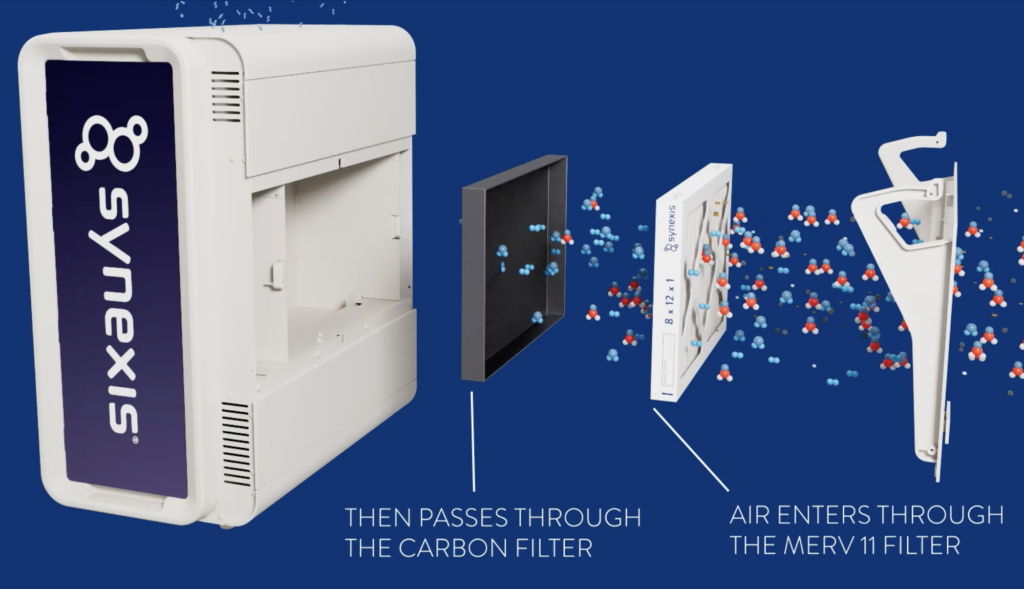
Synexis DHP® technology works on a different principle. Synexis devices convert ambient oxygen and humidity into dry hydrogen peroxide, a pure gas form of hydrogen peroxide. It isn’t a liquid spray or a vaporized fog. Unlike BPI’s sub-second-lived ions, dry hydrogen peroxide is a molecule that flows freely and continuously throughout enclosed treated spaces, reducing microbes in the air and on surfaces.
| Criterion | Bipolar Ionization | Synexis DHP® technology |
|---|---|---|
| Operates in occupied space | Yes. Designed to run with people present, usually through the HVAC system. | Yes. Designed for safe, continuous operation in occupied spaces. |
| Treats surfaces as well as air | Acts mainly on airborne particles. EPA large-scale testing found no meaningful difference in surface deposition vs. control. | Unlike BPI, whose surface-deposition results in EPA testing showed no meaningful difference versus control, DHP® technology has documented surface reductions across specific pathogens under stated conditions including in occupied patient rooms. |
| Continuous or cyclical | Runs when the air handler runs, so delivery follows the fan schedule. | 24/7/365 touchless and automated technology, no disruption of operations. |
| Staff labor and uptime | Low day-to-day staff involvement once installed. | Minimal routine, low-cost maintenance. |
| Enclosed and shadowed areas | Produces short-lived ions with a lifespan of less than 1 second after release. Reach follows supply airflow, and efficacy decreases as surviving-ion concentration falls with distance. | DHP is a stable molecule that flows freely through enclosed spaces, reducing pathogens in the air and on surfaces, including in hard-to-reach areas. |
| Depth and independence of evidence | Evidence is weighted toward chamber testing; the EPA notes that little research evaluates bipolar ionization outside laboratory conditions. | Evaluated in more than a dozen peer-reviewed studies and supported by independent third-party laboratory studies of effectiveness. |
Want to see how these 6 criteria apply to your building? Synexis offers a walkthrough and application assessment that sizes deployment to your space and its airflow. Request an assessment.
1. Continuous Operation in an Occupied Space
Both technologies are built for rooms that stay in use. That puts them in a different category from methods that need a room cleared, sealed, or taken offline.
DHP technology is safe for use in occupied spaces. The documentation behind that statement is specific:
- Meets requirements for OSHA safety, 29 CFR 1910.1000 Table Z-1.
- Certified to meet UL 2998 for zero ozone emissions.
- Meets California ozone emissions limit: CARB certified.
- Designed for continuous use in sensitive environments like NICUs and oncology units.
The difference is in what continuous means. Synexis devices run 24/7/365, through shift changes, overnight, and during the hours when the room is at its busiest.
2. Surfaces as Well as Air
This is one of the widest gaps between the two approaches. Unlike BPI, whose surface-deposition results in EPA testing showed no meaningful difference versus control, Synexis DHP® technology has documented surface reductions across a broad spectrum of pathogens. The efficacy of DHP technology is supported by independent, peer-reviewed published studies, and per-pathogen figures are reported with their conditions:
- Influenza Type A: 99.8% reduction on surfaces after the first 60 minutes vs. control (Data on File, SYN-0002).
- Staph. aureus (MRSA): >99.99% reduction on surfaces at 2 hours vs. control (Data on File, SYN-0006).
- Salmonella enterica: 91.62% reduction on surfaces at 6 hours vs. control (Data on File, SYN-0009).
- Candida auris: 89.0% reduction on surfaces within occupied patient rooms (Sutton et al., OFID).
These figures come from different test conditions than the ionization studies above, so they aren’t a head-to-head comparison. They show what the technology has documented on surfaces, under the conditions stated. The full list is on the pathogens page.
3. Continuous, Not Cyclical
A terminal clean, a UV cycle, or a fogging treatment resets a room to a known baseline. Then staff, visitors, and equipment start moving through again. Bipolar ionization runs as long as the air handler does, which in buildings with fan setbacks can mean reduced delivery overnight or on weekends.
The system is 24/7/365 touchless and automated technology, with no disruption of operations. It keeps working on the air and the surfaces after the cleaning program ends.
4. Staff Labor and Uptime
Here the two approaches are close. Once installed, both ask little of frontline staff. Neither needs an operator on the floor or a room taken out of service.
Synexis devices only require minimal routine, low-cost maintenance. Consumables are replaced periodically, and a facilities department can likely handle most of that work.
5. Enclosed and Shadowed Areas
Ions travel with the supply air and are short-lived, so their reach depends on where that air goes and how quickly. Dry hydrogen peroxide flows freely through the area and reduces pathogens in the air and on surfaces, even in hard-to-reach areas.
Deployment still matters. Synexis sizes each installation to the space and its airflow, and performance varies with microbial load and air movement.
6. Depth and Independence of Evidence
The decisive question is not whether a technology can produce a result in a chamber, but whether independent investigators have documented efficacy in real-world occupied environments. Synexis DHP technology has been evaluated in more than 13 peer-reviewed studies. Bipolar ionization has notably less independent evidence in real-world settings; the EPA specifically notes that little research evaluates the technology outside laboratory conditions.
Where Bipolar Ionization Still Has a Legitimate Role
An evaluation isn’t useful if it only finds strengths on one side. Bipolar ionization makes sense to consider in some situations:
- Particle management alongside higher-efficiency filtration. The large-chamber data above shows ionization adding PM2.5 removal efficiency when paired with MERV 10 or MERV 13 filters.
- Buildings already standardized on in-duct equipment. Where ionization is part of an established HVAC strategy, it can stay part of the air side of the plan.
- Whole-building air coverage with low staff involvement. For large common areas where airborne particles are the main concern, an in-duct system is a practical fit.
How The Criteria Apply by Facility Type
- Healthcare. Infection preventionists and EVS directors care about what happens between terminal cleans. Synexis technology can help support infection prevention strategies. It keeps working on the air and surfaces during and between cleanings.
- Food processing. Food safety and QA leaders need technology that runs during production. The technology is USDA Organic permitted, no chemical residues, 7 CFR 205.605.
- Higher education. Facility managers run residence halls, athletic facilities, and classrooms that are occupied most of the day and much of the night. Continuous operation matters more than cycle speed.
- Animal health. Practice managers deal with exam rooms, kennels, and equipment that stay in use. The technology helps create a sanitary and welcoming atmosphere for clients and animals.
What Should a Facility Ask Before Choosing Either Technology?
Use these questions with any vendor, including Synexis:
- How many independent and/or peer-reviewed studies validate efficacy in occupied, real-world settings rather than only in chambers?
- Was this tested in a sealed chamber, an occupied room, or both?
- What organism, medium (air or surface), timeframe, and comparator sit behind each figure?
- Does the technology act on surfaces, and what documentation shows it?
- Is the device certified to UL 2998 for zero ozone emissions?
- Which secondary byproducts were measured, and under what conditions?
- Does it run only when the HVAC fan runs, or on its own schedule?
- What routine maintenance does it need, and who on our team does it?
- How is deployment sized to our space, and where does performance fall off?
- Does it fit alongside our existing cleaning protocol without changing it?
Want to take a deeper look at bipolar ionization and how the technology performs in real-world environments? Read our whitepaper, Bipolar Ionization: Understanding the Difference Between Theory and Practice, for an expert perspective on the science, applications, and considerations behind this approach to indoor air quality.
Frequently Asked Questions
What is bipolar ionization and how does it work?
Bipolar ionization uses high voltage to create positively and negatively charged ions from molecules in the air, usually inside the HVAC system. The ions cause airborne particles to cluster so filters can capture them more easily, and they interact with some airborne microbes.
How does bipolar ionization compare with dry hydrogen peroxide?
Both are designed for occupied spaces, but their active agents behave differently. Bipolar ionization produces ions that typically persist for less than 1 second after release, so coverage and efficacy decline as surviving-ion concentration falls with distance. Synexis DHP® technology uses ambient water and oxygen to produce the pure gas form of hydrogen peroxide that flows freely through enclosed spaces and reduces pathogens in both the air and on surfaces, 24/7/365. DHP technology also has evidence from peer-reviewed studies in real-world settings, including occupied patient rooms in healthcare facilities.
Does needlepoint bipolar ionization actually work?
Results depend on where it’s tested. EPA chamber testing reported reductions of an airborne surrogate virus, while a 2024 lecture hall study found no significant difference in culturable airborne bacteria with the ionizer on or off. The EPA notes that little research evaluates the technology outside of lab conditions.
Are bipolar ionizers safe?
The EPA states that bipolar ionization has the potential to generate ozone and other by-products unless specific precautions are taken in design and maintenance. It recommends devices certified to UL 2998 for zero ozone emissions. Ask vendors which secondary byproducts were measured and under what conditions.
What does the EPA say about ionization devices?
The EPA calls bipolar ionization an emerging technology, notes that little research evaluates it outside of lab conditions, and says the evidence for safety and effectiveness is less documented than for filtration.
Which approach works in a space that stays occupied?
Both run with people present. The differences are coverage and continuity. Synexis DHP® technology is designed for safe, continuous operation in occupied spaces and treats air and surfaces, while bipolar ionization acts mainly on the air and runs when the air handler runs.
What should a facility ask before specifying either technology?
Ask whether results come from a sealed chamber or an occupied room, what organism, medium, timeframe, and comparator sit behind each figure, whether the device is UL 2998 certified, which byproducts were measured, and how deployment is sized to your space.
Does DHP® technology replace existing cleaning and sanitation programs?
No. Synexis DHP® technology supports and enhances existing cleaning and sanitation protocols as an added layer of 24/7 microbial control. Your existing cleaning practices are part of a layered approach to pathogen control, DHP technology is the continuous and proactive layer that keeps working on the air and surfaces.
See How The Criteria Apply to Your Facility
Every facility already runs a cleaning and sanitation program. Synexis DHP® technology is what keeps working on the air and the surfaces during and after that program ends: continuously, in occupied spaces, without changing how anyone works.
The best way to test the 6 criteria is against your own floor plan. A Synexis walkthrough and application assessment looks at your space, its airflow, and how it’s used, then sizes a deployment to fit.
Request a walkthrough and application assessment
Synexis® is a pathogen control technology company. Synexis Systems are regulated by the US Environmental Protection Agency and state governments as devices. Accordingly, our Systems are produced in an EPA-registered facility and packaged and labeled in accordance with EPA regulations appearing at 40 CFR 152.500. Product claims, regulatory status, and approved uses may vary by region. Please contact Synexis® for information specific to your country.